- September 2025: INCOME TAX RAIDS ON DEFAULTING RUPPs: In the last 3-4 years, in addition to its analysis of National and Regional political parties' finances, ADR's Political Party Watch (PPW) team initiated a detailed review of the status of submission of financial statements of Registered Unrecognised Political Parties (RUPPs). It found that certain defaulting parties were not submitting their annual reports and were not contesting elections regularly while receiving large sums of funds each year. The reports’ findings were shared with the Election Commission of India. Many RTI applications were filed at the state-level with Chief Electoral Officers to raise this matter, which led to show cause notices being issued to defaulting parties. These reports have also been covered by several media outlets, creating awareness among the public and generating momentum around this issue. The Election Commission has taken rigorous steps to delist inactive RUPPs over the last few years. The Income Tax authorities also took cognisance and conducted raids on the defaulting parties.
To know more, visit this link. - April 2024: The Supreme Court refused ADR's prayer for counting of 100% VVPATs in all EVMs but directed ECI to:
- seal and store Symbol Loading Unit (SLU) for a period of 45 days and
- a system of cross-verification on a request made by candidates in serial numbers 2 and 3 within 7 days after the declaration of results.
To know more about the two directions, visit this link.
- February 2024: On ADR's petition challenging the Finance Act, 2017; Electoral Bonds and Removal of company's limit, the Supreme Court gave a landmark judgment in favour of ADR by holding the anonymous, unregulated and unlimited funding through electoral bonds and companies as unconstitutional.
- March 2023: On ADR's petition challenging the constitutional validity of the practice of the appointment of Chief Election Commissioner and Election Commissioners by the Executive, the Supreme Court gave a landmark judgment in favour of ADR by directing the appointment of Members of the Election Commission to be done on the advice of a committee comprising the Prime Minister, Chief Justice of India and the Leader of Opposition (or the leader of the single largest opposition party) in the Lok Sabha.
- February 2018: On a petition of Lok Prahari regarding disproportionate asset increase of the MPs & MLAs, Supreme Court made it mandatory for candidates to declare sources of income of spouse & dependents in Form 26 of affidavits. ADR had intervened in the matter & also provided all the necessary data.
- September 2016: Maj Gen Anil Verma (Retd), Head of ADR, participated as a speaker in Second Forum of Citizen Observers, two-day event organized by European Commission in Brussels, Belgium, on 15-16 September 2016. It brought together citizen observer groups and civil society organisations from all over the world with representatives of international institutions to discuss current challenges to election observation. For full report click here.
- August 2016: Prof. Trilochan Sastry, Chairman ADR, represented ADR at the 3rd Asian Electoral Stakeholder Forum (AESF III) conference in Bali, Indonesia.
- May 2014: In Ashok Chavan paid news case, the Supreme Court had passed a judgment holding that Election Commission of India (ECI) has the power to disqualify a candidate in relation to filing of false election expenditure statement under Section 10A of RPA. ADR had intervened in the case supporting the stand of the ECI.
- September 2013: The Supreme Court ruled that the right to register a "none of the above (NOTA)" vote in elections should apply and ordered Election Commission to provide such a button in the Electronic Voting Machines (EVM). ADR had intervened in the matter.
- July 2013: Supreme Court delivered a Judgment on a petition filed by Lily Thomas and Lok Prahari NGO, (ADR Intervened) setting aside clause 8(4) of the Representation of the People Act. As a result of which sitting MPs and MLAs were barred from holding office on being Convicted in a Court of Law.
- June 2013: The Central Information Commission (CIC) in an effort towards making political parties transparent as well as accountable in their functioning, declared the six national parties BJP, INC, BSP, CPI, CPI(M) and NCP as public authorities. All six parties refused to comply with CIC's order. In 2015, a petition was filed by ADR in the Supreme Court to implement CIC's order by bringing them under the preview of Right to Information Act, 2005.
- December 2012: ADR/NEW released an analysis of the number of politicians charged with crimes against women. ADR/NEW's recommendations and data was also widely quoted by the Justice Verma Committee in its report.
- October 2012: The Election Commission asked the Ministry of Home Affairs to probe violations of the Foreign Contributions Regulation Act (FCRA) and the Representation of Peoples' Act (RPA) by major political parties which reportedly received foreign contributions.
- June 2011: After a two-year-long RTI battle, crucial information on the 'Registers of Members' Interest' was finally mandated by the Central Information Commission (CIC) to be available in the public domain in June 2011.
- January 2011: Details of the movable and immovable assets of 30 Bihar ministers, including that of CM Nitish Kumar, were uploaded on the government website in January, 2011.
- Feb 3, 2010: Prime Minister Manmohan Singh asked his Cabinet colleagues to disclose details of their assets and liabilities and refrain from dealing with the government on immovable property.
- Jan 25, 2010: Both the Congress President Ms. Sonia Gandhi and the Leader of Opposition in Lok Sabha Ms. Sushma Swaraj of BJP made public statements calling for a consensus on barring candidates with criminal backgrounds from contesting elections.
- 2009: The number of total serious IPC sections against MPs decrease from 296 in Lok Sabha 2004 to 274 in Lok Sabha 2009.
- 2009: A large number of candidates with serious pending cases that contested Lok Sabha 2009 elections like Pappu Yadav, Atiq Ahmed, Mukhtar Ansari, Akhilesh Singh, etc. lost.
- 2008: Overall, the percentage of candidates with pending criminal cases came down from 20% to 14% in the assembly elections held in the country in 2008 for the states of Rajasthan, Chhattisgarh, Madhya Pradesh, NCT of Delhi and Mizoram.
- 2008: In the Karnataka Assembly Elections, 2008, there was a reduction in the number of candidates with serious offenses put up by parties. It came down to 93 in 2008 from 217 in the 2004.
- April 2008: ADR obtained a landmark ruling from the Central Information Commission (CIC) saying that Income Tax Returns of Political Parties would now be available in the public domain along with the assessment orders.
- 2005: Bihar Election Watch in October‐November 2005 resulted in intense pressure on the Chief Minister Designate due to the extensive media coverage of candidate background. As a result, for the first time, Bihar has a Council of Ministers without any known criminal record.
- September 2003: A Bill on Electoral Expenses was passed in September 2003. The EC has taken it one-step forward and asked candidates to file a statement of expenses in every three days during the campaign.
- May 2002 and March 2003: ADR's petitions resulted in a landmark judgment by the Supreme Court of India by making it mandatory for the candidates contesting elections to Parliament and State Assemblies to file self sworn affidavits (Form 26) declaring full information regarding their criminal, financial and educational background. In keeping with the spirit of the judgement, at the All India State Election Commissioners' (SEC) Conference held in July 2003, all the State Election Commissions had unanimously resolved to implement the disclosure rules in local body elections.
- 2002: The Election Commission completed a massive exercise based on the Gujarat Election Watch report to verify information filed by candidates in the nomination papers and affidavits, and has started proceedings against candidates with false declarations.
- 16th October 2024: The Jaivic Bharat Mission conferred on ADR the Hon'ble Mr Justice D. S. Tewatia Memorial Award for Outstanding Contribution to National-Development. For pictures, click here. For more information, click here.
- 04th October 2024: The Delhi High Court Bar Association and Live4Freedom LLP conferred the Fight 4 Justice Awards, II Edition, 2024 in the “Administration & Governance” category on the Association for Democratic Reforms (ADR) for its fight against the Electoral Bond Scheme, which was declared unconstitutional by the Supreme Court of India.
On behalf of ADR, Prof Jagdeep Chhokar (Founder Member & Trustee of ADR) and Maj Gen Anil Verma (Retd) (Head of ADR) received the award at the hands of Hon'ble Mr Justice N Kotiswar Singh, Hon'ble Judge of the Supreme Court of India. For pictures, click here. For more information, click here. - 27th April 2024: The Yashraj Bharati Samman 2024 was awarded to the Association for Democratic Reforms in the category of "Ethical Governance".
On behalf of ADR, Prof Trilochan Sastry (Chairman, Founder Member & Trustee of ADR) and Maj Gen Anil Verma (Retd) (Head of ADR) received the award at the hands of renowned child rights activist and Nobel laureate, Shri Kailash Satyarthi ji, at New Delhi. For pictures, click here. For more information, click here. - 25th January 2024: Ms Rolly Shivhare, Madhya Pradesh State Coordinator of ADR, received an Appreciation Certificate from Betul and Bhopal District Election Office for the outstanding ADR voter awareness campaign conducted during the Madhya Pradesh Assembly Elections 2023. For picture, click here.
- 01st February 2020: ADR's Mera Vote Mera Desh campaign was declared Winner for 2019-2020 in "Governance & Livelihood" category for raising awareness about a clean legislature & political representatives by Digital Empowerment Foundation under their "eNGO Challenge". The eNGO Challenge aims to recognize and facilitate the grassroots organizations doing exceptional work using Digital Tools across South Asia. For picture, click here. For more information, click here.
- 25th January 2020: The Election Commission of India (ECI) awarded National CSO Award to Association for Democratic Reforms (ADR) (on the occasion of the 10th National Voters' Day) for taking up measures for electoral awareness by organizing district level conference aiming togetherness with synergizing efforts towards strengthening democracy during Lok Sabha Election, 2019.
On behalf of ADR, Maj Gen Anil Verma (Retd), Head of ADR & National Election Watch, received the award at the hands of the President of India, Shri Ram Nath Kovind in the presence of Shri Ravi Shankar Prasad (Union Minister for Law & Justice, Communications, Electronics & Information Technology), CEC and other Election Commissioners. For picture, click here. - 27th July 2019: ADR received the first Democracy Award in the category of "Increasing Citizens' Participation in Electoral Process" (Instituted by Maharashtra State Election Commission) at the hands of Hon'ble Vice President of India, Shri M. Venkaiah Naidu.For picture, click here.
- 25th January 2019: ADR's Madhya Pradesh Coordinator, Ms Rolly Shivhare, received an Appreciation Certificate at the hands of the Madhya Pradesh State Election Commissioner on National Voter Awareness Day for successfully organising a voter awareness campaign in Madhya Pradesh. For picture, click here.
- November 2015: ADR won an award of outstanding achievement in the 2015 category of "Citizen's Engagement" at the International Electoral Awards 2015 from iCPS. For picture, click here.
- 25th January 2015: National Election Watch and Association for Democratic Reforms won Election Commission of India's prestigious National CSO Award – 2014 for “Best Voter Education and Awareness for General Election to Lok Sabha 2014” on the occasion of National Voters' Day. State Election Watch chapters of Bihar, Odisha, Madhya Pradesh, Maharashtra and Uttar Pradesh have received special mention in the award.
- 29th April 2014: Awarded the NDTV Indian of the Year- India's Future' in "Public Service" category. For video click here.
- 25th March 2014: Awarded Innovation for India Awards 2014 by Marico Innovation Foundation under the "Social" category. For video, click here. For pictures, click here.
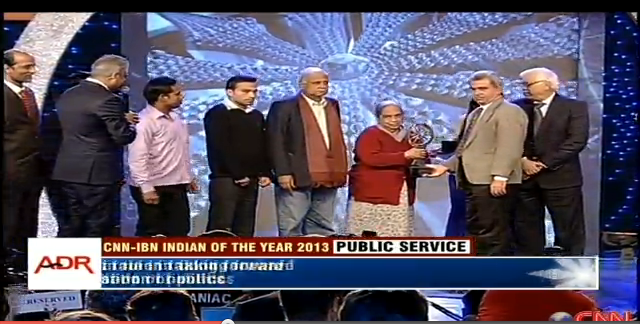
- 20th December 2013: Awarded the CNN IBN Indian of the Year Award in the category of "Public Service", along with Ms Lily Thomas. For picture, click here.
- January 2013: Awarded the Times of India Social Impact Award in "Advocacy and Empowerment" category. For more information, click here.
- August 2012: ADR won the mBillionth Award South Asia in the category of 'Mobile Innovations for Good Governance' by Digital Empowerment Foundation (DEF) for its PULL SMS programme which allows every mobile user in the country to get information (criminal, financial and educational details) about his/her MP and MLA by sending a simple SMS from his/her phone. For videos, click here and here. For more information, click here.
- December 2011: ADR won the NASSCOM Award for "ICT led Innovation" by Multi-stakeholder Partnership for its Election Watch Software with Webrosoft. For video, click here.